
 Call:


Music and Memory
Travelling Through Time With Music
Less debatable than Albert Einstein's theory of relativity, time travel through music has actually been proven. Anyone you ask has likely already experienced it: listening to an old tune that is dear to us, we find ourselves all at once overwhelmed by memories. If it is linked to a precise moment, be it happy, sad or innocuous, it's all in the context of the moment, the faces, the places, sounds and smells that come back to us in memory.
The Reminiscence Bump
The phenomenon of music time travel is particularly evident with regard to music heard during our childhood and adolescence. Music psychologists and scientists Carol Krumhansl and Justin Zupnick identified this phenomenon in 2013 as the "reminiscence bump:" listening to a melody, whether you personally like it or not, generates a more immediate effect when linked to our early years more than for any other. According to Krumhansl, "Music transmitted from generation to generation shapes autobiographical memories, preferences, and emotional responses, a phenomenon we call cascading ‘reminiscence bumps.’”
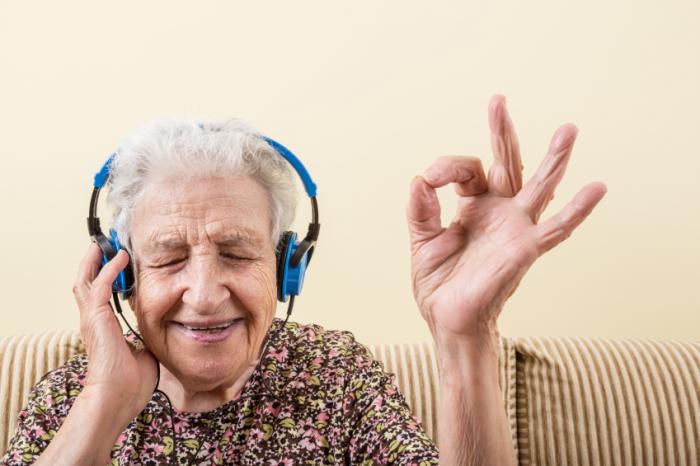 How can such a phenomenon be explained?
The researcher and neuropsychologist Hervé Platel explained that: "We can obviously feel an intense pleasure listening to something new." But the neuropsychologist Robert Zatorre, in Montreal, has shown this in neuroimaging: even when you hear something new, your brain is actually doing an associative calculation in terms of what it knows: 'What does this song make me think of? ... Ah yes, it reminds me of this one song…. We're always trying to analyze this new information in light of past experiences. You're never completely starting fresh, even if you are listening to new music." Our brain is like a nostalgic registry, constantly looking to the past to search for musical or contextual references.
Healing purposes
Such an influence on the neurological system has led scientists to consider possible medical usage. If music is able to to establish a lasting place in our memory, can music have the ability to reactivate certain sleeping cognitive abilities caused by degenerative diseases such as Alzheimer's? Everything points to yes since studies have shown that patients are able to hum melodies heard in their youth even when they were unable to remember their first name. Similarly, people who have suffered a stroke were also able to identify certain musics despite being struck with aphasia (inability to speak).
Effects on the brain
The explanation may come from the path taken by music to nestle in the depths of our brain. After music goes through our ear canal, it takes less than a 250 thousandth of a second for this information to be treated by our brains. And just like a Christmas tree that lights up, your cranial box activates the parts related to emotions (the desire to cry or jump with joy), motor skills (the desire to dance), language (the desire to to sing) and of course, memory. And if on top of that, we hear a tune that we like, it is like the cherry on top, as our brain releases dopamine, the pleasure hormone.
Above all, music, as information, is processed by the brain automatically and stored in our "implicit" memory. That's why information related to a particular music remains accessible to a patient of Alzheimer's disease even though certain functions, such as speech, can no longer be activated.
 And then contrary to popular belief that a brain can only be split into two parts (one that manages the mathematical part and the other the artistic), the two hemispheres of the brain are both used when listening to music. The area on the left, linked to language, is used as much as the other side that is linked to perceptual analysis. So, if the first is damaged, the other remains active, which goes further to explain the case of patients mentioned above.
We are very grateful to Karaoke Version - https://www.karaoke-version.co.uk/ - for much of this interesting article. They specialise in professional quality backing tracks which many entertainers use when they visit care homes. Music has quite simply, the power to unlock those hidden memories and engage people to sing word perfect, even when communicating normally is challenged.
Care homes up and down the country use singers and musicians to great effect on a daily basis, underpinning the importance activities play in every care home, whether it's residential or nursing care that's being provided.
Looking for a care home for you, or a loved one, to Live Your Life?
Call 01892 556 500 to arrange a visit to Rusthall Lodge Care Home
Serving Rusthall, Langton Green, Tunbridge Wells and the surrounding areas in Kent and Sussex
Residential care, Nursing care, Respite care
Written on 18th September 2018